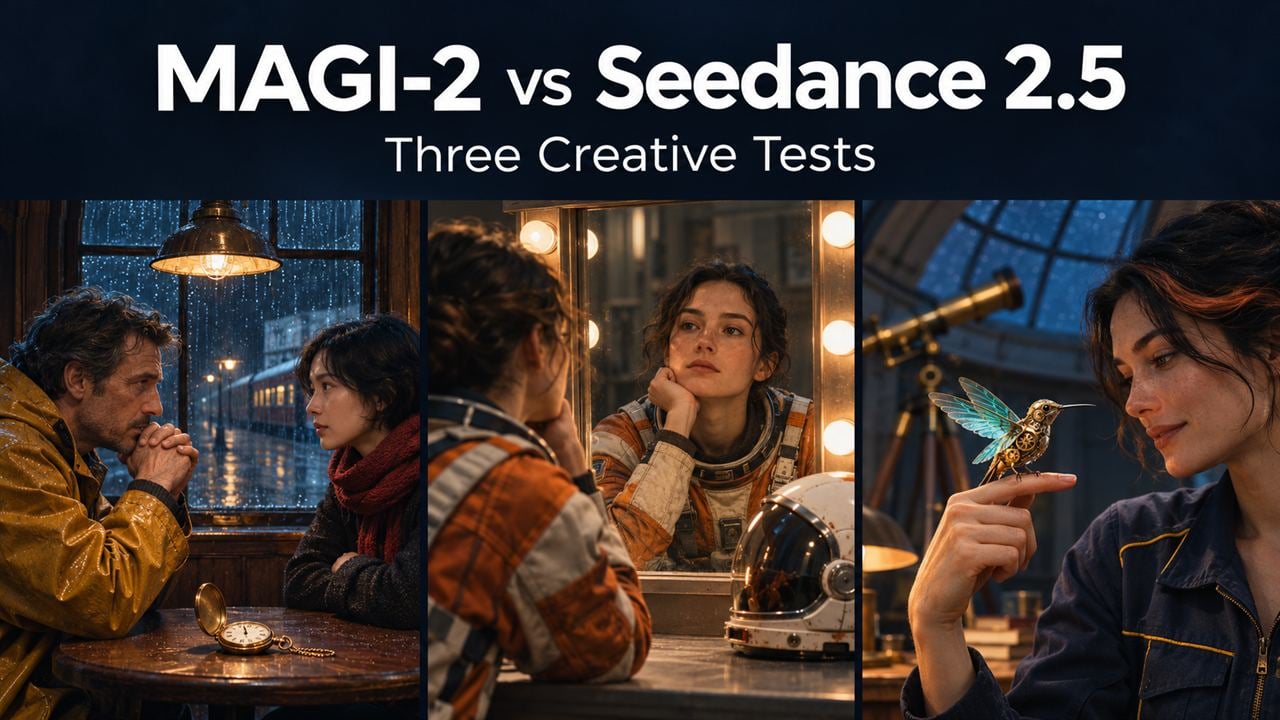
MAGI-2 costs substantially less than Seedance 2.5 on PixExact, but what does that difference look like in a finished scene? We gave both models the same three creative tasks: a supernatural conversation, an astronaut putting on a helmet in front of a mirror, and a mechanical hummingbird assembled from three image references. Each model got one generation per task, giving us six videos to compare.
The main actions often worked, but closer inspection changed the comparison. Seedance 2.5 achieves the requested reverse rain, while MAGI-2 misses that effect and its opened watch develops an extra cover. Both astronaut clips take a shortcut with the helmet's orientation, while Seedance also misses the requested opening breath. In the hummingbird scene, we slightly prefer Seedance's more refined-looking finish. MAGI-2's clearest advantage is cost: 90 credits per clip against Seedance's 420 at the tested settings.
How we compared MAGI-2 and Seedance 2.5
Each pair used the same English prompt, requested length, resolution, aspect ratio and sound setting. The image-to-video pair shared one starting image. The reference-to-video pair shared three images: a character, a mechanical bird and an observatory. No reference video or reference audio was used.
| Setting | Both models |
|---|---|
| Requested video length | 15 seconds |
| Resolution | 1920 × 1080 |
| Aspect ratio | 16:9 |
| Generated sound | On |
| Generations per scene | One per model |
| Prompt revisions or rerolls | None |
These are three case studies, with one example of each input mode. They show how the models handled these particular scenes, rather than establishing an overall win rate. We compared the visible action, subject and object continuity, and adherence to the brief. Dialogue was checked separately; we did not assign a voice-naturalness or frame-accurate lip-sync score.
The supplied files contain approximately 15 seconds of picture and sound. Seedance's video streams are 24 fps and MAGI-2's are 25 fps, so the requested settings match without the files having identical frame timing.
Text to video: a pocket watch that changes the rain
This text-to-video scene needed more than a cinematic atmosphere. A man in a yellow raincoat had to slide a brass watch to a woman in a red scarf. She then had to open it, exchange two short lines with him, and notice the existing rain trails flowing upward after the ticking stopped.
The difficult part was keeping the event order and assigning each action to the correct person, then making one precise supernatural change while the rest of the scene continued normally.
Seedance 2.5 result
Seedance chose a dark, enclosed composition, with the two characters seated opposite each other and the rainy window between them. The watch passes across the table, the woman lifts it and opens its cover, and the camera moves closer without abandoning the two-person arrangement. Both requested dialogue lines are present.
Seedance also delivers the final supernatural effect: the rain on the window flows back upward near the end. Together with the watch exchange and dialogue, this completes the central action sequence in the brief. The dark, restrained lighting supports the thriller atmosphere without replacing the requested rain effect.
MAGI-2 result
MAGI-2 uses a brighter composition with more of the station platform visible through the window. The closed watch is easy to locate at the beginning. Its transfer, opening and the subsequent conversation are readable, and the two requested lines are present here as well.
The prop changes during the opening. Around five seconds, two raised cover-like pieces flank the watch dial. The extra lid is easy to miss in the wider composition, but becomes clear when looking at her hands. The action has happened, yet the watch no longer has the simple single-cover opening we intended.
The rain becomes more conspicuous near the end, but its trails bend into repeated fountain-like arcs. That is a strong visual signal of something supernatural, rather than a faithful reversal of the existing runoff. The woman also raises her gaze in response, preserving the intended final reaction.
Our preference for this text-to-video scene: Seedance 2.5. It achieves the reverse rain and avoids the extra-cover appearance seen in MAGI-2's watch. MAGI-2 tells the basic story and presents the scene clearly, but the changed prop and missed rain reversal leave it less faithful to this particular brief.
The shared text prompt
A photorealistic supernatural thriller scene inside a deserted railway-station waiting room at night. Rain runs down the outside of a large window beside a small wooden table.

A middle-aged man in a mustard-yellow raincoat sits on the left. An adult woman with short dark hair and a red wool scarf sits on the right. There is exactly one closed brass pocket watch on the table.

One uninterrupted shot. The camera slowly pushes toward the table, keeping both faces, their hands and the watch visible.

0–4 seconds:
The man slides the closed watch across the table with his right hand. The woman stops it with her left hand. The watch remains in contact with the tabletop during the slide.

4–7 seconds:
The woman lifts the watch and opens its hinged cover with her other hand. A small metallic click is followed by clearly audible ticking.

7–11 seconds:
Looking at the man, the woman quietly says, “You’re late.”
The man looks back at her and replies, “Not yet.”
Only the assigned speaker moves their lips during each line.

11–15 seconds:
The ticking abruptly stops. Only then, the existing rain trails on the outside of the window reverse direction and flow upward. The woman notices this and slowly raises her eyes toward the window, still holding the same open watch.

Natural skin texture, restrained acting, warm station lighting against cold blue rain. Keep both characters’ faces and clothing consistent. The upward rain is the only supernatural effect; people and objects continue moving normally.

Audio: steady rain, quiet room tone, the watch-cover click, ticking that stops at the specified moment, and the two spoken lines. No music, narration, subtitles or cuts.
Image to video: an astronaut and her reflection
For image to video, both models started from this exact image. The astronaut, orange-and-white suit, helmet, mirror and lighting were already established. The task was to animate her lifting the helmet onto her head, securing it, lowering the visor and turning toward the camera to say “Ready.”
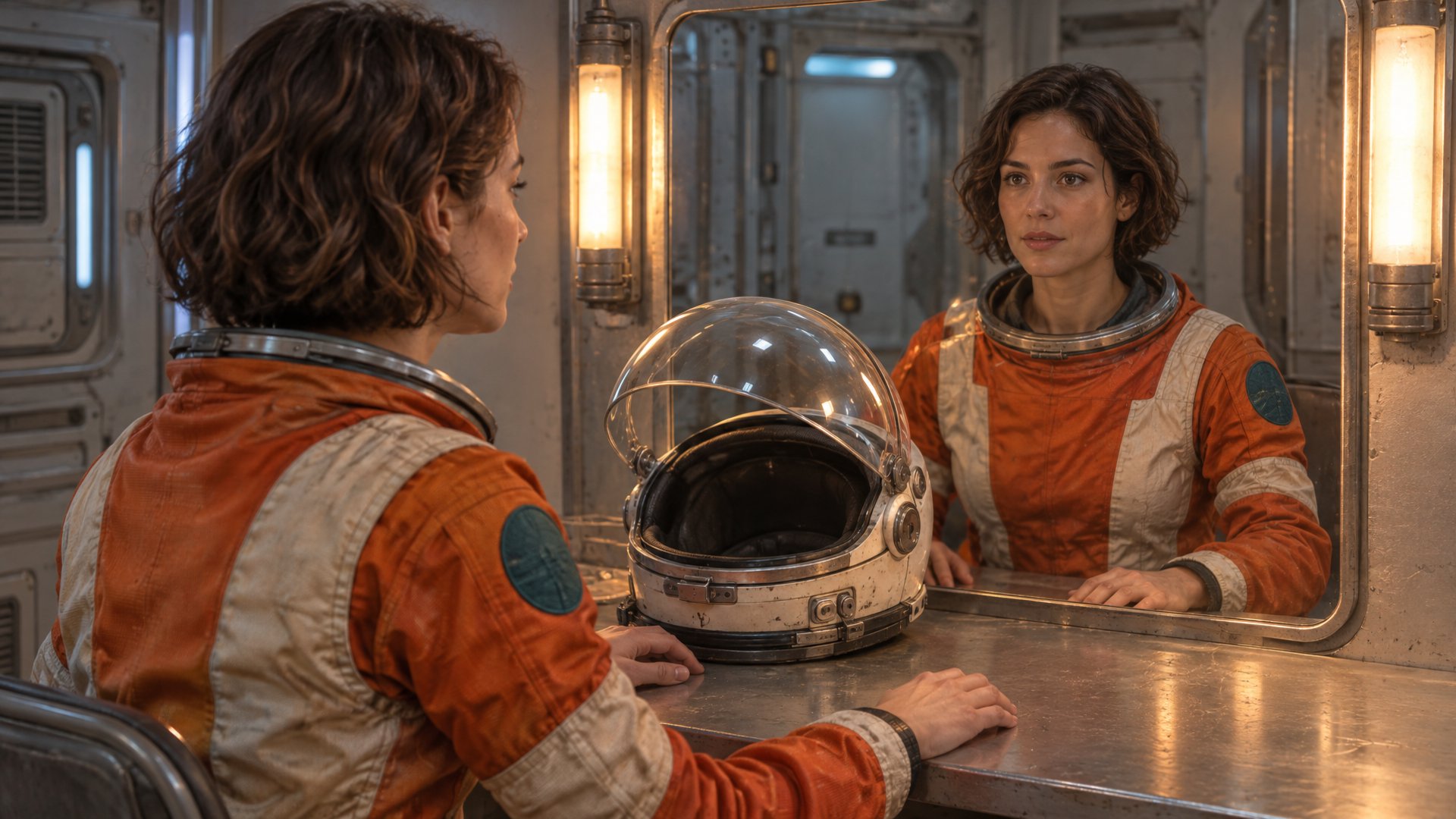
This tests continuity through handling and occlusion. A successful result needs the same person after the helmet goes on, a helmet that remains a single solid object, and a reflection that follows the physical action. We judged the newly generated movement rather than treating the starting image as a perfect mirror-geometry reference.
Seedance 2.5 result
Seedance preserves the source image's warm lighting and worn suit texture. The astronaut reaches for the helmet, lifts it clear of the table, raises it above her head and lowers it into place. Her reflection broadly follows those stages. The table is left clear, and she turns toward the camera at the end with her face visible through the visor. The requested word “Ready” is present.
It does not clearly perform the quiet preparatory breath requested at the beginning. This is a smaller omission than a broken helmet movement, but it matters to the intended performance: the scene was supposed to begin with a deliberate pause before departure.
The helmet handling has a more substantial shortcut, shared with MAGI-2. She does not visibly rotate the helmet into the correct wearing orientation before lowering it. The raised visor appears oriented the wrong way during placement, then resolves into the correct position once the helmet is on. The final pose looks plausible, but the transition does not fully explain how the object got there.
MAGI-2 result
MAGI-2 also completes the main sequence, including the final turn and “Ready.” The suit's orange-and-white design and shoulder patch remain recognizable, and the ending gives us a clear view of her face inside the helmet.
It shares Seedance's helmet-orientation problem. The necessary turn is skipped, and the visor's orientation effectively corrects itself as the helmet settles into place. Reaching the requested end pose is therefore not the same as preserving a physically coherent action all the way through.
The reflection exposes the larger problem. During roughly the sixth and seventh seconds, the reflected helmet is already coming down around her head while the helmet on the near side of the mirror is still being held higher above her hair. The two views no longer describe the same stage of the movement. At normal viewing size, the action can look plausible because each side independently resembles someone putting on a helmet.
Our take: neither model passes the complete helmet-handling test. Seedance stays close to the starting image's appearance and has the more coherent reflected lifting progression, but misses the opening breath and shares the orientation shortcut. MAGI-2 reaches the final pose too, with a more conspicuous mismatch between the real and reflected action. The hand, helmet, visor and reflection need to work together throughout the movement, not just in the last frame.
The shared image-to-video prompt
She glances at her own reflection, takes a quiet breath, and prepares to leave.

0–3 seconds:
She studies her face in the mirror with a restrained, slightly nervous expression. Her hands remain beside the helmet.

3–9 seconds:
She grips the same helmet with both hands, lifts it off the table, raises it above her head and carefully lowers it into place. The tabletop where the helmet rested is now empty.

9–12 seconds:
She secures the helmet at the collar and lowers the transparent visor. Her face remains recognizable through the glass.

12–15 seconds:
She turns her head slightly toward the camera and quietly says, “Ready.” Her mouth movement matches the word, followed by a small, determined smile.

Preserve the starting image’s person, facial proportions, hairstyle, orange-and-white suit, shoulder patch and room layout. Keep the hand-to-helmet contact physically continuous. Her reflection must perform the same actions at the same time, with correct mirror geometry.

One continuous shot with a very slow, subtle camera slide to the left. Natural real-time motion and realistic materials.

Audio: soft ventilation, fabric movement, quiet helmet handling, a small visor-latch click and her single spoken word. No music, additional dialogue, subtitles or cuts.
Reference to video: waking a mechanical hummingbird
The third test used reference to video with three separate images. The models had to combine a person, an object and a location, then make them interact. The images did not supply a finished opening frame.
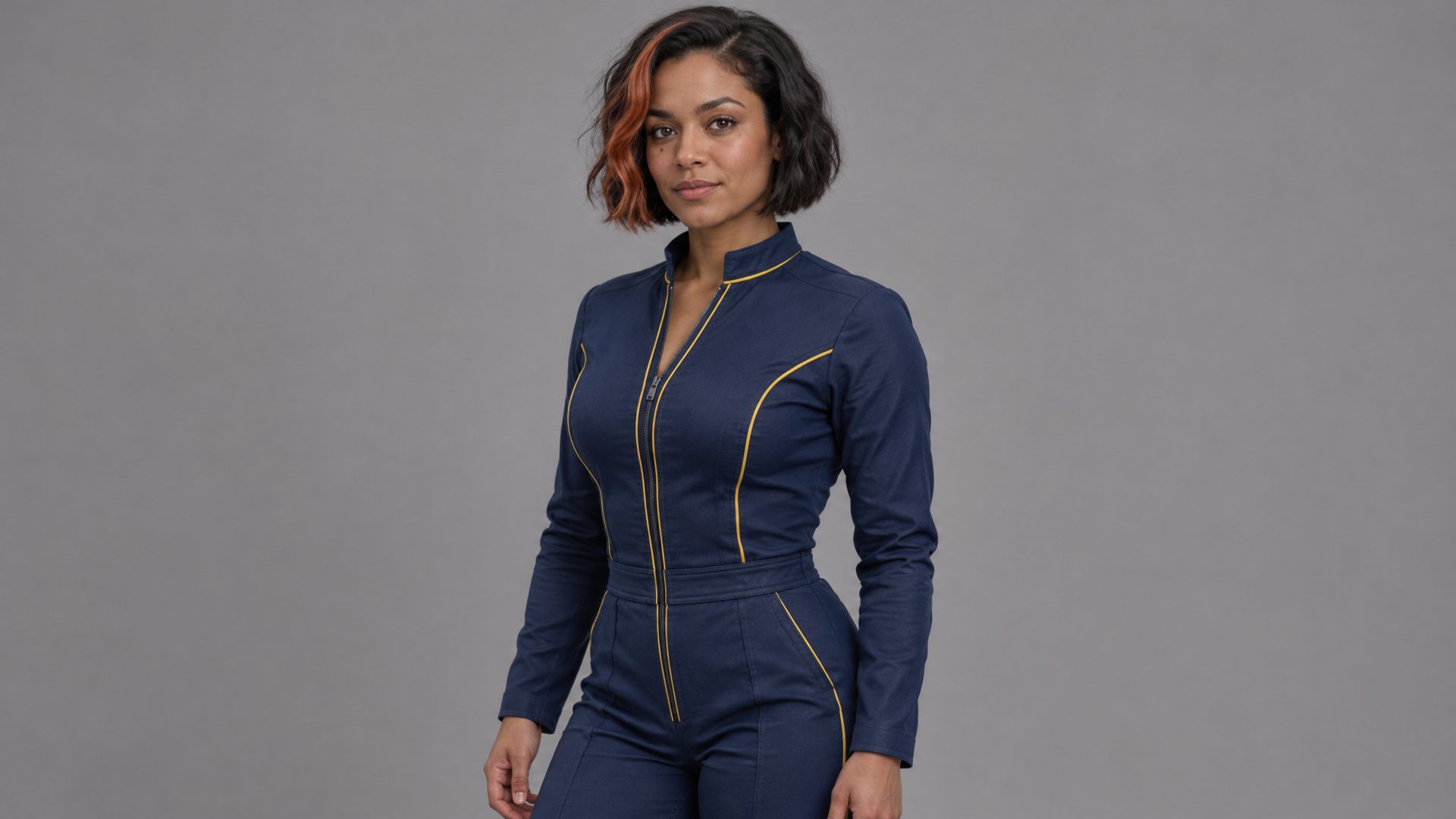
Character reference — Image 1
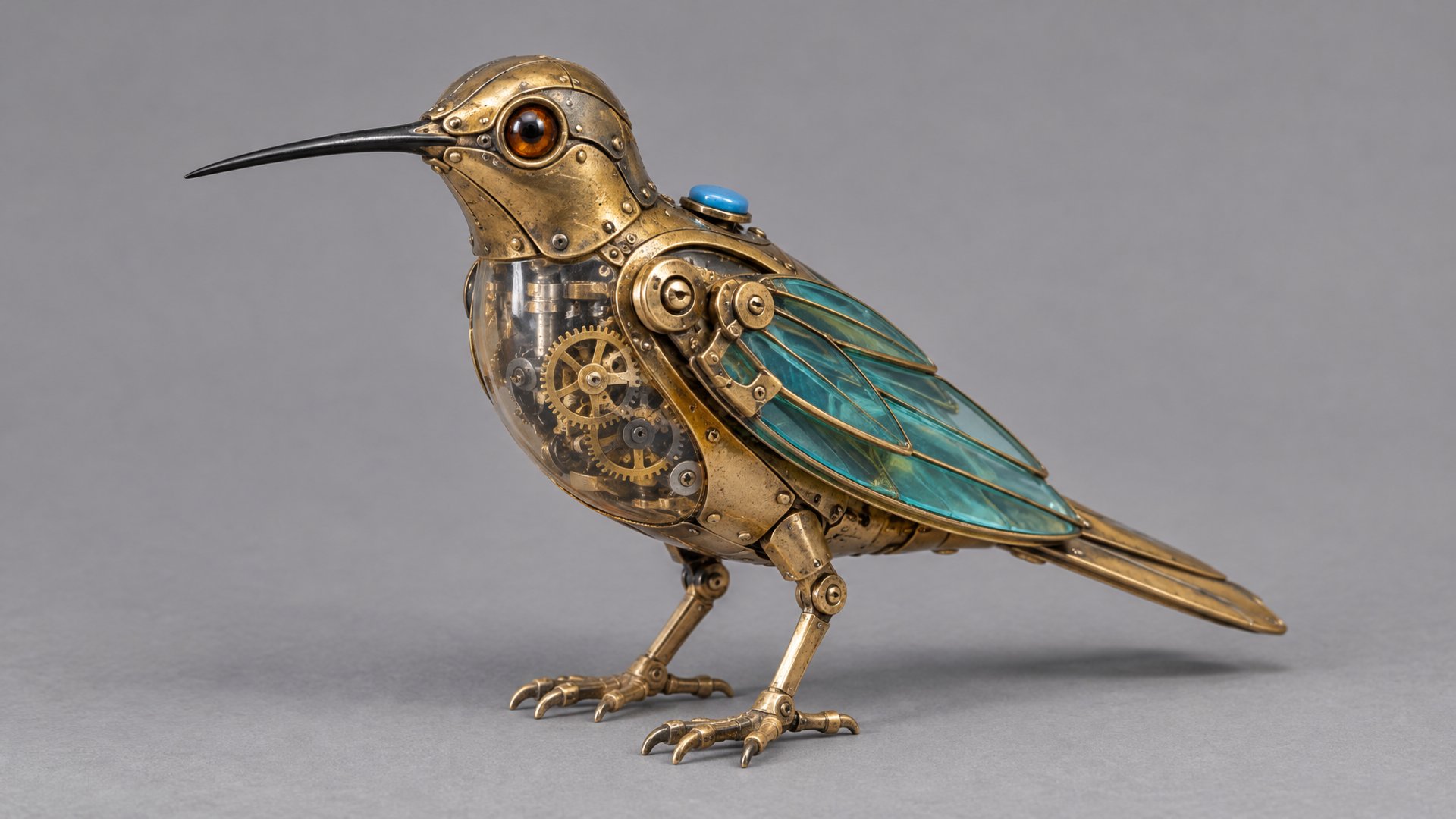
Mechanical bird reference — Image 2
Observatory reference — Image 3
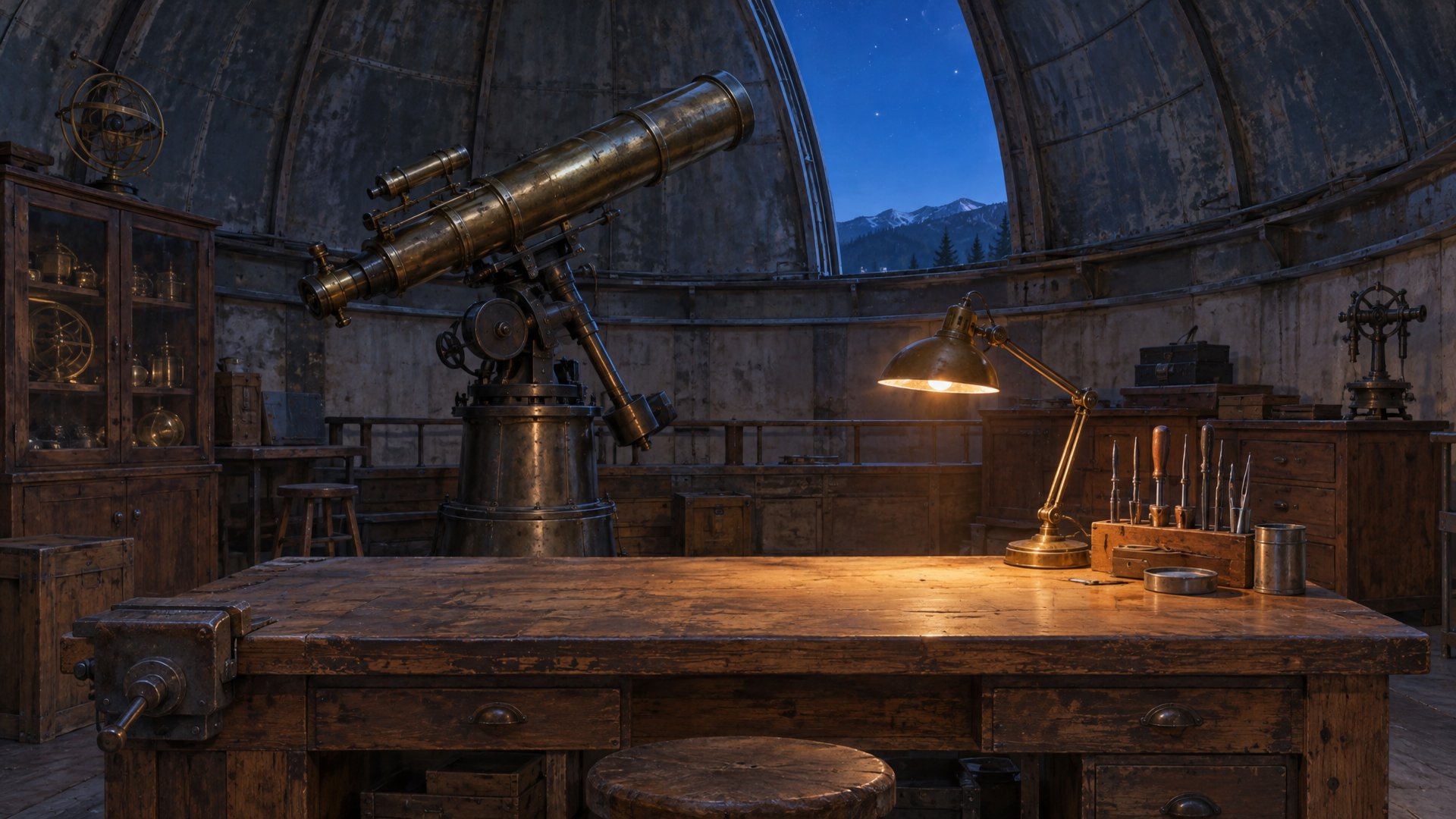
The brief was specific: steady the bird, press its back button, let it unfold its wings and hover, then have it land on an extended finger before folding its wings. The woman would finish with “There you are.” This makes the interaction and sequence as important as the opening composition.
Seedance 2.5 result
Seedance places the woman close to the bench, leaning toward a relatively small bird. The warm desk lamp strongly shapes the lighting, with the telescope and blue opening of the dome visible behind her. Her copper hair streak, navy outfit and the bird's brass-and-turquoise palette carry through.
The action chain works: the bird is handled and activated, spreads its wings, rises from the bench, then approaches the offered finger and perches. Its wings fold after landing, and the closing line is present. We slightly prefer the overall visual finish here: the warm light and softer tonal transitions give the character and setting a more refined feel.
That preference does not make the object reproduction exact. The bird's fine mechanical details simplify during flight, and its dangling feet look elongated in several hovering frames. The overall interaction is easier to follow than those small structural details are to trust.
MAGI-2 result
MAGI-2 begins wider, showing the woman standing behind the bench and more of the supplied observatory layout. The yellow piping and copper hair streak are easy to recognize. Its bird is presented at a larger scale than Seedance's, making the brass body, wing color and long beak more visible.
It also follows the activation, takeoff, hover and landing sequence. The finger arrives beneath the bird, its feet meet the hand, and the wings fold as the scene settles into the closing line. The exposed perch and larger subject make the final interaction particularly readable.
It is still a reinterpretation of the bird reference. The illuminated eye becomes distinctly red-orange, and the transparent chest and small gear arrangement are not reproduced exactly. If this were a real product rather than a fictional prop, those details would require a separate fidelity check.
Our visual preference for this pair: Seedance 2.5, by a small margin. Both models accomplish the main reference-based task, but Seedance's treatment feels more refined overall. MAGI-2 gives the source character and location a clear presentation and completes the interaction at a lower credit cost. That is a separate advantage from visual finish. Neither preserves every mechanical detail, so we would not call either output an exact reproduction of the supplied object.
The shared reference-to-video prompt
REFERENCE ROLES:
@image1 defines the woman’s identity, face, hairstyle and navy-blue jumpsuit.
@image2 defines the mechanical hummingbird’s brass body, turquoise wings, amber eyes, black beak and blue activation button.
@image3 defines the observatory, repair bench, telescope, dome and lighting.

Create a photorealistic science-fiction scene in the observatory. The woman stands behind the repair bench. Exactly one mechanical hummingbird rests on the tabletop in front of her, initially motionless with its wings folded.

One uninterrupted shot. Begin in a medium view showing her face, both hands and the bird. Slowly push closer, keeping her face, the bird and the landing hand visible.

0–4 seconds:
She gently steadies the bird with her left hand and presses the blue button on its back once with her right index finger. Its amber eyes illuminate.

4–9 seconds:
She releases the bird. Its two turquoise wings unfold at their mechanical joints, then begin beating rapidly. The bird lifts vertically from the bench and hovers approximately 20 centimeters above it.

9–12 seconds:
She extends her left index finger horizontally beneath the hovering bird. The bird descends, places both brass feet onto her finger and folds its wings.

12–15 seconds:
Keeping her hand steady, she looks at the perched bird and softly says, “There you are.” The bird tilts its head toward her.

Preserve her identity and clothing throughout. Keep the same bird design, size and materials during activation, flight and landing. The bird remains visible throughout its path; no disappearance, duplication or transformation into a living bird. Its feet must visibly contact her finger before the wings fold.

Audio: quiet observatory room tone, one small button click, mechanical wing movement rising into a delicate whir during flight, then slowing as it lands, followed by her spoken line. No music, narration, subtitles or cuts.
What the sound adds to these tests
All six videos contain audio. Both text-to-video outputs include “You're late” and “Not yet”; both astronaut clips include “Ready”; both reference clips include “There you are.” Delivering those short lines is useful, but it is only one part of audio quality.
The missing opening breath in Seedance's astronaut clip is another reminder to check the performance around the spoken line. The watch prompt also asks for a click, ticking and an abrupt stop before the rain changes. The bird prompt ties a mechanical whir to takeoff and landing. Those are separate requirements from speaking the correct words. We have not awarded either model an audio winner based on the presence of dialogue alone. Play the original clips with sound on when deciding whether their voices and effects suit your project.
MAGI-2 vs Seedance 2.5 cost on PixExact
At the PixExact rates checked on November 28, 2026, a 15-second 1080p generation costs 90 credits with MAGI-2 and 420 credits with Seedance 2.5. These examples use no reference video, so the same output-length calculation applies to all three modes. Generated sound is included at these rates.
| Test | MAGI-2 | Seedance 2.5 |
|---|---|---|
| Text to video, 15 seconds | 90 credits | 420 credits |
| Image to video, 15 seconds | 90 credits | 420 credits |
| Three-image reference, 15 seconds | 90 credits | 420 credits |
| Three generations per model | 270 credits | 1,260 credits |
The six outputs total 1,530 credits at those rates, excluding the creation of the input images. That is a pricing calculation, rather than a claim about generation speed or how many attempts a different project will need. Check the displayed total before generating, especially if adding reference video or changing resolution.
For the price of one 420-credit Seedance clip, the same balance covers four 90-credit MAGI-2 clips with 60 credits left. That gives MAGI-2 a practical advantage for exploring a scene. It does not establish the cost of a finished usable shot: we did not reroll these tests to measure how often each model succeeds.
Which model would we choose for these scenes?
| If this is the part you care about | What these examples suggest |
|---|---|
| Exploring a cinematic scene on a smaller credit budget | Start with MAGI-2; its lower price did not prevent it from completing the main actions in these examples. |
| A person handling an object in front of a prominent mirror | Neither astronaut clip fully passed. Both skipped a clear orientation change; MAGI-2 also had the more conspicuous reflected-motion mismatch. |
| Combining a character, a fictional prop and a location | Both completed the hummingbird sequence. We slightly preferred Seedance's visual finish; MAGI-2 cost less. |
| A precise supernatural effect with a literal motion rule | Seedance 2.5 achieves the reverse rain in this text test; MAGI-2 does not. We preferred Seedance for this brief. |
| Exact object geometry and construction details | Inspect handling as well as the final pose. MAGI-2 added a watch cover, both helmets changed orientation mid-action, and both bird outputs changed fine details. |
MAGI-2 gives us more room to explore on the same credit balance. Seedance 2.5 is our choice for the text scene because it achieves the reverse rain, and we slightly prefer its reference scene's visual finish. Its higher price still did not eliminate the helmet-handling problem or guarantee every performance cue. We would choose between these particular outputs by weighing the finish and instruction-following we prefer against the errors that would need another generation or an edit.